
In the fast-paced ecosystem of TikTok, storytelling has evolved from a traditional linear format into a high-speed psychological game. In 2026, the average user decides whether to stay or swipe in less than two seconds. To succeed, you must compress a narrative arc—setup, conflict, and resolution—into a window that is often shorter than a commercial break.
Effective short-form storytelling isn't about cutting your content down; it is about building it up with intentional hooks and rapid-fire value. Whether you are a brand or an individual creator, mastering this skill is the only way to satisfy the TikTok algorithm’s demand for high completion rates. This guide provides a technical and practical framework for telling compelling stories in under 60 seconds.
1. Mastering the 3-Second Hook to Stop the Scroll
The first three seconds of your video are the most critical. This is your "narrative contract" with the viewer. If you fail to promise a payoff immediately, you lose the audience.
- The "In-Media-Res" Start: Begin your story in the middle of the action. Don't say, "I went to the store today." Instead, start with, "I can't believe the manager actually said this to me."
- Visual Curiosity: Use a visual that contradicts the audio. If you are telling a sad story, start with a high-energy transition. The brain seeks to resolve this incongruity, forcing the viewer to keep watching.
- Text Overlay Stakes: Place bold text on the screen that establishes the conflict immediately. For example: "The mistake that cost me $5,000."
By establishing the stakes instantly, you bypass the "intro fatigue" that plagues low-performing content.
2. Structuring Your 60-Second Narrative Arc
A story without structure is just a series of clips. To keep a viewer engaged for 60 seconds, you must follow a modified version of the classic three-act structure.
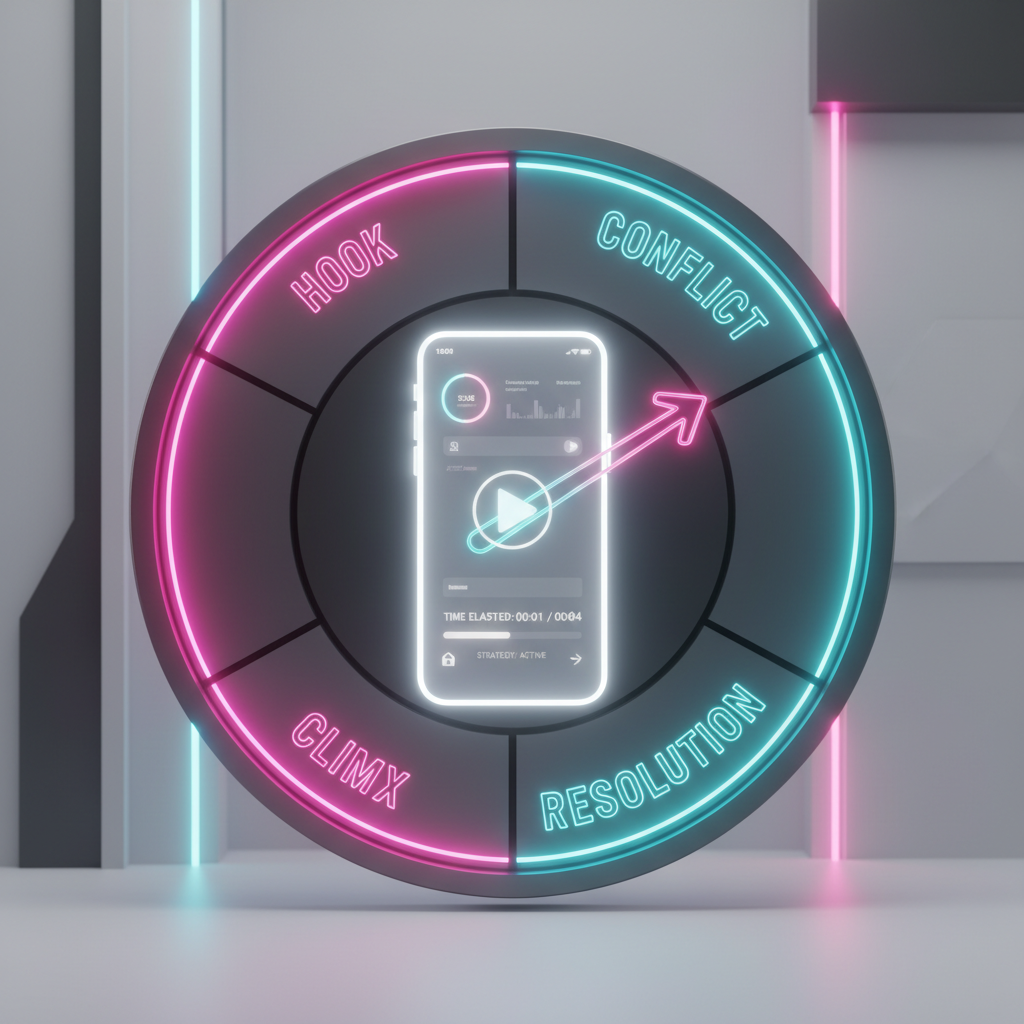
- The Hook (0-5 seconds): Define the problem or the curiosity gap.
- The Rising Action (5-40 seconds): Provide context through rapid-fire shots. Use jump cuts to remove every breath and pause.
- The Climax (40-50 seconds): Deliver the most important piece of information or the funniest moment.
- The Resolution/CTA (50-60 seconds): Close the loop and tell the viewer what to do next.
This structure ensures that the pacing feels intentional rather than rushed. Every second must serve the goal of moving the viewer toward the resolution.
3. Using Visual Pattern Interrupts to Maintain Retention
Human attention is fragile. To maintain a high completion rate, you must "reset" the viewer's focus every 4 to 6 seconds using pattern interrupts.
- Dynamic Zooming: Change the camera scale from a medium shot to a close-up during a pivotal realization.
- Text Transitions: Pop key words onto the screen as you say them. This caters to "sound-off" viewers and reinforces the narrative.
- B-Roll Integration: If you are talking about a specific event, overlay 2 seconds of footage from that event. Visual variety prevents "talking head" fatigue.
When analyzing successful storytelling patterns, creators often need to study high-performing videos in high definition. You can download TikTok videos without watermark using Savettok.org, which is FREE, FAST, and ONLINE. This allows you to archive and analyze the exact timing of pattern interrupts in viral videos without the distraction of platform logos.
4. The Role of Original Audio and Voiceovers in Storytelling
In 2026, the TikTok algorithm prioritizes original audio over trending songs for storytelling content. Authenticity is a major "Trustworthiness" signal.
- ASMR Storytelling: Use the natural sounds of your environment (a keyboard clicking, coffee brewing) to ground the story in reality.
- The "Confessional" Style: Speak directly into the microphone at a close range. This creates an intimate, "secret-sharing" vibe that performs exceptionally well in the storytelling niche.
- Emotional Inflexion: Vary your tone. Monotone delivery is a retention killer. If the story is exciting, your voice must reflect that energy.
5. Eliminating Verbal Filler for Maximum Density
In a 60-second window, you don't have time for "um," "so," or "anyways." Verbal filler is essentially a "swipe here" sign for the viewer.
- Scripting for Brevity: Write your script and then remove 20% of the words. Focus only on the nouns and verbs that drive the action.
- The Jump Cut Technique: Edit your video so that the next sentence starts the millisecond the previous one ends. This creates a sense of momentum that is addictive to watch.
- Subtitles as Narrative: Sometimes, the text on the screen can tell a secondary part of the story, allowing you to convey two pieces of information at once.
6. Creating Emotional Resonance in Short-Form Content
Data shows that videos triggering strong emotions (awe, anger, amusement, or empathy) have 3x higher share rates. Storytelling is the vessel for these emotions.
- The "Relatability" Factor: Share a struggle that is common to your niche. If you are an IT specialist, talk about the universal frustration of a server crash at 4:55 PM on a Friday.
- Vulnerability: Admitting a mistake or a failure builds "Authoritativeness" because it shows you have the "Experience" to know better now.
- The Payoff: Ensure the ending of your story provides an emotional release. Whether it's a joke or a profound lesson, the viewer needs to feel that their 60 seconds were well-spent.
7. How to Use the "Looping" Technique for Rewatch Value
If a viewer watches your video twice, the algorithm views it as a "super-engagement" signal. Telling a story that loops seamlessly is a technical masterstroke.
- The Seamless Transition: Make the last sentence of your video lead perfectly into the first sentence.
- Visual Matching: End the video in the exact same physical position or setting where you started.
- The Cliffhanger Loop: End on a question that is answered by the very first frame of the video.
High rewatch rates are the fastest way to move from the 200-view jail to the millions.
8. Practical Solutions for Technical Storytelling Editing
Effective editing is what separates a "vlog" from a "story." Use these technical solutions to polish your 60-second narrative:
- Color Grading for Mood: Use warmer tones for nostalgic stories and cooler, high-contrast tones for tech-heavy or serious narratives.
- Sound Mixing: Ensure your voiceover is at least 10dB louder than your background music. If the viewer has to strain to hear your story, they will leave.
- Frame Composition: Keep the most important visual element in the "safe zone" (the center of the screen) where it won't be covered by the TikTok UI elements.
9. Real Use-Case: The "Problem-Solution" Story
A creator in the DIY niche wanted to tell a story about fixing a broken shelf.
- The Hook: A shot of the shelf collapsing with the sound of breaking glass. Text: "I almost lost everything."
- The Conflict: Explaining that a standard fix wouldn't work because of the wall type.
- The Climax: Discovering a unique anchoring technique.
- The Resolution: The shelf holding a heavy weight, followed by a tip for the viewers.
- The Result: 85% completion rate and a surge in "Topical Authority" for home improvement.
10. Summary: The 60-Second Storyteller’s Checklist
Before you post your next narrative, run through this checklist to ensure it is optimized for the 2026 algorithm:
- Is there a visual or verbal hook in the first 2 seconds?
- Have all verbal fillers and silent pauses been removed?
- Does the video feature a pattern interrupt every 5 seconds?
- Is the resolution satisfying or does it provide value?
- Are the captions keyword-rich for TikTok SEO?
Mastering the art of brevity is a career-long journey, but once you can tell a story in under a minute, you have the keys to the most powerful attention economy in the world.
Frequently Asked Questions
Can a 60-second video really tell a full story?
Yes. Storytelling is about the change in state—from problem to solution or from ignorance to knowledge. By focusing on the "pivotal moment" rather than every detail, you can deliver a complete emotional arc in 45 to 60 seconds.
Does the TikTok algorithm prefer 60-second videos over 15-second ones?
In 2026, TikTok is pushing for longer-form content (1 minute+). However, for storytelling, 60 seconds is the "sweet spot" that allows for enough depth to build "Authoritativeness" while still being short enough to maintain a high completion rate.
Should I script my TikTok stories?
Absolutely. Even if you want to sound "natural," having a script ensures you don't ramble. A script allows you to identify exactly where to place your hooks and pattern interrupts for maximum impact.
How do I come up with storytelling ideas daily?
Look at your "Experience." Every frustration, success, or weird interaction you have in your professional or personal life is a potential story. The key is to frame it as a lesson or a relatable moment for your specific audience.
Do I need a professional camera for TikTok storytelling?
No. Authenticity often performs better than high-end production. A modern smartphone with a clean lens and good lighting is all you need. Focus on the "Expertise" of your content rather than the pixel count.
Is it okay to repurpose my TikTok stories for Reels?
Yes, but ensure you remove the watermark first. Platforms like Instagram often deprioritize videos with visible logos from competitors. Using a reliable tool to download TikTok videos without watermark is the best way to ensure your storytelling remains "platform-native" wherever you post it.


