
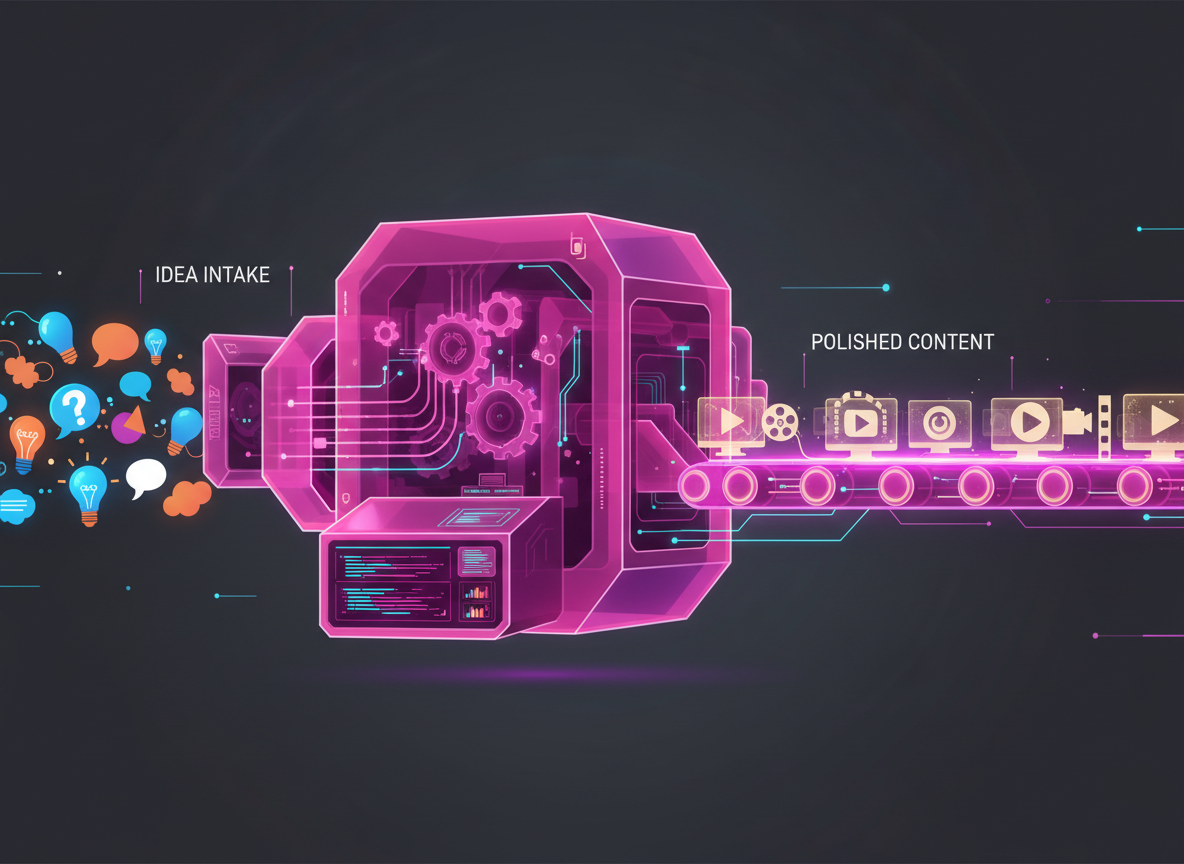
The primary reason creators fail isn't a lack of talent; it is the total absence of a sustainable production architecture. Most people approach content creation as a series of isolated, high-effort sprints fueled by temporary bursts of inspiration. When that inspiration inevitably wanes, the output stops, the algorithm loses interest, and the creator faces the crushing weight of "starting over." This cycle of boom and bust is the root cause of professional burnout. To solve this, you must stop being a "content creator" and start becoming a "content architect," building a system where the creation of media is an automated byproduct of your daily professional and personal activities.
1. Establishing a Sustainable Content Production Workflow
A successful workflow is designed to minimize the "friction of starting." If you have to decide what to film, find your gear, and set up your lighting every time you want to post, you will eventually quit. Consistency is a byproduct of preparation.
- Fixed Environment: Keep a dedicated space for recording that is permanently ready. This includes static lighting and a pre-configured microphone.
- Templated Editing: Use preset color grades, text styles, and transition patterns in your editing software to reduce post-production time by 60%.
- Administrative Batching: Handle all metadata, caption writing, and hashtag research in a single block of time once a week.
By treating production as a technical process rather than an artistic event, you remove the emotional drain of the "blank canvas." You are no longer waiting for a muse; you are executing a checklist.
2. The Mechanics of Batching Content for Maximum Efficiency
Batching is the practice of performing similar tasks in a concentrated timeframe to capitalize on "flow state." Switching between filming, editing, and replying to comments creates a heavy cognitive load known as context switching. This is one of the fastest ways to deplete your mental energy.
Instead of creating one video per day, set aside one day to film ten videos. Because your brain is already in "performance mode," the tenth video will often be better and produced faster than the first. Once the filming is complete, dedicate the next day entirely to editing. This specialization allows you to refine your technical skills in each area more deeply. For those who leverage research to fuel their batching sessions, using a high-utility web resource like Savettok.org is a massive time-saver. It is a fast and free online tool that helps you collect reference videos to your PC without watermark, allowing you to build an offline library of structural examples that you can reference during your batching hours.
3. Creating a High-Authority Content Pillar System
The "Pillar System" is a strategic method where you create one substantial, high-value piece of content and then "atomize" it into dozens of smaller assets. This ensures your expertise (the 'E' in EEAT) is consistently presented across different platforms without requiring you to reinvent the wheel every day.
For example, a technical deep dive on server maintenance can be atomized into:
- A long-form video explaining the full process.
- Five short-form clips highlighting specific "quick fixes."
- Three text-based graphics focusing on essential hardware checklists.
- A series of "Before and After" photos.
This approach ensures that your content is cohesive and that you are maximizing the ROI on every hour you spend in production. You are not searching for new ideas; you are simply presenting your core expertise in different formats to satisfy different audience segments.
4. How to Use Content Automation Tools Safely
Automation is the only way to scale your output beyond the limits of your own time. However, many creators use automation incorrectly, leading to "robotic" profiles that fail the trust test. True automation should handle the distribution, not the creation.
- Scheduling Platforms: Use tools like Buffer or Later to schedule your posts weeks in advance. This removes the daily anxiety of "having to post."
- AI Transcription: Use software to automatically generate captions. While you must check them for technical accuracy, it removes the manual labor of typing.
- Workflow Integration: Use Zapier or similar tools to automatically move edited videos from your storage to your scheduling queue.
When the distribution is automated, your only job is the high-level strategy and the actual filming. This separation of powers is essential for long-term psychological sustainability.
5. Overcoming Creative Block with Data Driven Research
Creative block is usually a symptom of a lack of input. You cannot output high-quality information if you are not constantly consuming and analyzing data. Instead of waiting for an idea to strike, look at the "Pain Points" being discussed in industry forums, Reddit, or comment sections.
Use your search history to find what people are actually struggling with. If you see ten people asking how to configure a specific router, that is a data-driven content idea. It requires no "creative" energy because the audience has already provided the script. By solving actual problems, you build Trustworthiness (the 'T' in EEAT) and ensure that every piece of content you produce has a built-in audience waiting for it.
6. Developing a Realistic Content Calendar for Growth
A content calendar should be a reflection of your capacity, not your aspirations. If you plan to post five times a day but your schedule only allows for one, you will inevitably feel like a failure, which leads directly to burnout.
Start with a "Minimum Viable Consistency." If you can only commit to two high-quality posts per week, do that perfectly. As your systems improve and your editing becomes faster, you can scale up to three or four. The algorithm values the "predictability" of your account. If you post every Tuesday and Thursday without fail, you will build a more loyal and engaged audience than someone who posts ten times in one week and then disappears for a month.
7. The Role of Content Repurposing in Preventing Exhaustion
Repurposing is not "lazy"; it is an efficient use of assets. Your older content is a goldmine of value that new followers haven't seen yet. Every six months, you should review your high-performing posts and update them with new information.
- Format Swapping: Turn a successful voiceover into a text-overlay video.
- Update and Re-post: If a technical guide you made a year ago is still relevant, update the visuals and re-publish it.
- The "Best Of" Compilation: Group several related videos into a longer "Masterclass" format.
This reduces the pressure to be a "new idea machine." By treating your content library as an evolving ecosystem rather than a disposable feed, you protect your energy and ensure that your best work continues to drive results long after its initial release.
8. Prioritizing Mental Health in the Creator Economy
The technical side of creation is useless if the human behind the screen is depleted. Digital burnout is a physical reality that affects your cognitive function and decision-making abilities. You must build "Off-Ramps" into your schedule.
Strictly separate your "Consumption" time from your "Creation" time. If you spend all day scrolling, your brain is in a passive state, making it harder to flip the switch to active creation. Set boundaries for when you engage with comments and analytics. Checking your views every ten minutes provides a cortisol spike that is unsustainable. Schedule "Digital Detox" periods where you focus on physical tasks—like hardware maintenance or offline planning—to let your creative "well" refill.
9. Leveraging Community Feedback for Content Ideas
Your audience is your best research department. Instead of guessing what they want, use polls, Q&A stickers, and direct questions in your videos. This "Interactive Expertise" creates a feedback loop that simplifies the creation process.
When you allow your community to dictate the topics, the content becomes "self-writing." You are simply a technical consultant answering the public's questions. This removes the ego from the process and makes the creation feel more like a service and less like a performance. When you are serving your community, the work feels inherently more meaningful, which is a powerful natural defense against the cynicism and exhaustion that leads to burnout.
10. Frequently Asked Questions
What are the first signs of creator burnout?
The earliest signs are a dread of the recording process, a drop in the quality of your editing, and an increasing irritability toward your audience. If you find yourself procrastinating on tasks that used to be easy, it’s a technical signal that your system is overloaded.
How many videos should I film in one batching session?
For beginners, filming 3 to 5 videos is a realistic goal. As your systems improve, you can scale up to 10 or 15. The key is to stop before you feel physically exhausted, so you don't associate the filming process with pain.
Does repurposing content hurt my reach?
No. Most of your followers do not see every post due to the way algorithms function. Repurposing allows you to reach the segment of your audience that missed the original post, while also reinforcing your expertise to those who did see it.
How do I stay consistent with a full-time job?
You must rely entirely on batching. Dedicate four hours on a Saturday to filming and two hours on a Sunday to editing. This gives you a full week of content that can be automatically posted while you are at work.
Should I delete low-performing videos?
No. Deleting videos can sometimes confuse the algorithm's understanding of your account's history. Unless a video has a technical error or is outdated, leave it up. Many videos experience "delayed virality" weeks after they are posted.
What is the most important tool for consistency?
A robust Content Calendar. Whether it’s a simple spreadsheet or a dedicated app like Trello, having a visual map of what is being posted and when is the only way to manage the complexity of a high-volume publishing schedule.


